




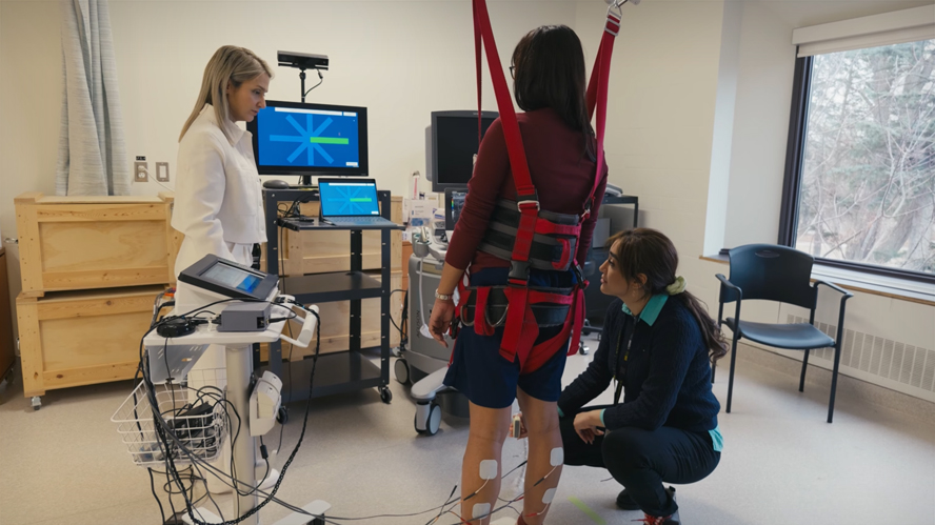
alance rehabilitation aims to help people with neurological impairments restore and improve motor control. Visual feedback balance training and electrical stimulation (pictured above) use visual cues and muscle activation to support better balance control. (Image Credits: Qin Dai, Biomedical Engineering at the University of Toronto)
Testing a depth camera as a more accessible tool for balance rehabilitation.
Restoring balance and motor function for people with neurological conditions and impairments, including spinal cord injury, is critical for maintaining quality of life. However, current rehabilitation therapies often have limited clinical accessibility because they rely on expensive and specialized equipment. New research from UHN’s KITE Research Institute found that a low-cost depth camera may offer a more accessible and practical approach for delivering balance rehabilitation.
Specialized therapies that combine visual feedback balance training (VFBT) and electrical stimulation can help improve standing balance. VFBT uses visual cues to help people adjust their body position and improve balance and stability. Combining VFBT with functional electrical stimulation (FES), which sends electrical pulses to activate muscles in the lower legs, can enhance the effects of rehabilitation by helping the nervous system relearn movement patterns and improve motor control.
Currently, the VFBT-FES system relies on a force plate—a specialized device that measures how a person’s weight shifts while standing—to guide training exercises and signal when electrical stimulation should be delivered. However, force plates are costly and not widely available in rehabilitation settings, limiting access to these therapies.
To develop a more accessible alternative, the researchers evaluated how accurately a depth camera, which tracks movement in 3D, could measure a person’s body position to guide balance training and electrical stimulation.