




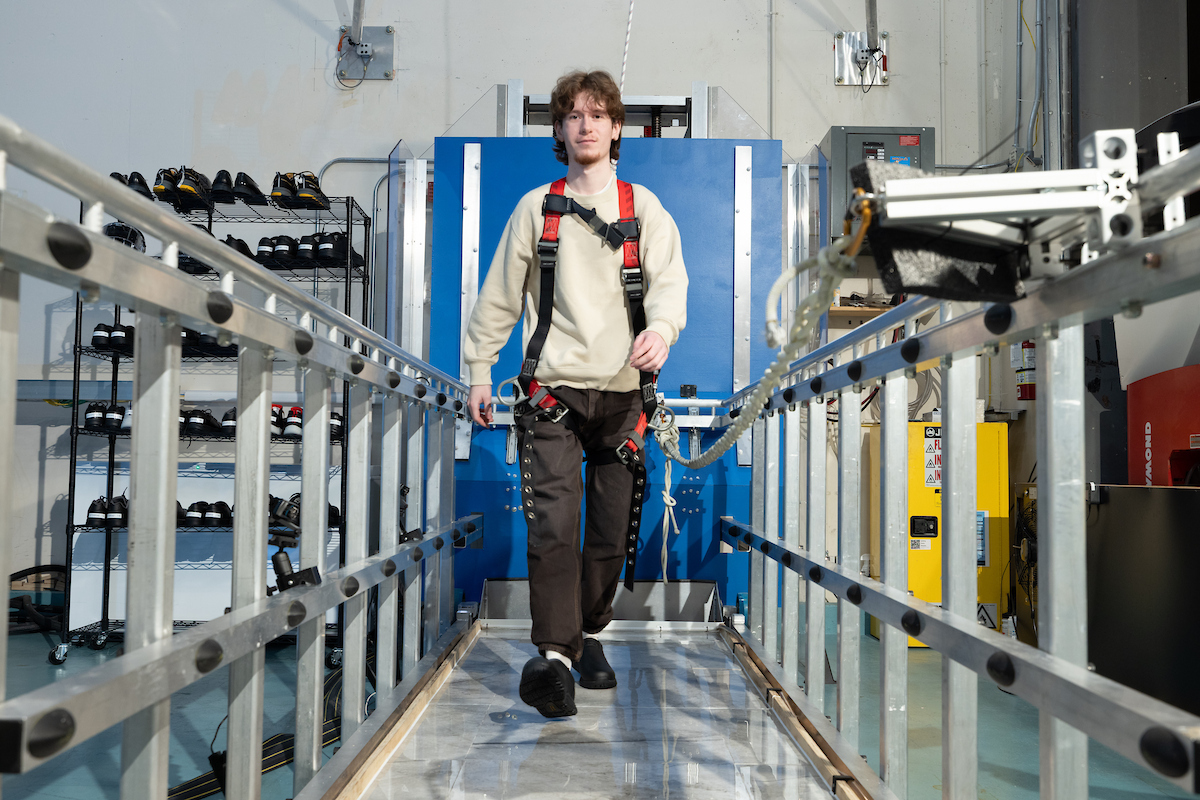
KITE's RampLab allows researchers to test shoe's slip-resistance on wet tiled floors similar to those you would find in workplaces and homes.
New WaterDrop rating from KITE's Rate My Treads program measures the traction of footwear on wet indoor flooring.
A new science-backed rating from UHN's KITE Research Institute helps workers and employers compare the slip resistance of occupational and safety footwear, with the goal of reducing workplace injuries from slips and falls.
The new WaterDrop rating is part of KITE's Rate My Treads program, which tests footwear and shares the results publicly to help people choose shoes with better traction. For more than nine years, Rate My Treads has tested winter boot traction on ice. Expanding it to include non-winter footwear was a natural next step, says Dr. Sophia Yue Li, a staff scientist at UHN's KITE Research Institute and lead of its Rate My Treads program.
"Slips and falls are not just a winter problem," she says. "They happen year-round in workplaces, and the right footwear can make an important difference in preventing them."
The fifteen shoes tested this year were all from Mark's, a long-standing Rate My Treads partner. Through this collaboration, Mark’s engaged KITE to conduct independent footwear testing using standardized protocols to create objective evaluations for consumers.
How does KITE test shoes for slip resistance?
WaterDrop ratings are based on a human-centred testing method developed at KITE. Wearing a safety harness and the footwear being evaluated, study participants walk back and forth across a tiled surface in KITE's RampLab. Researchers gradually increase the angle of the surface until the footwear can no longer provide enough grip and the participant begins to slip.
Each shoe is tested by four participants on both wet and dry surfaces. The results are then translated into a rating from zero to three WaterDrops - with three representing the highest possible rating - and published online on the Rate My Treads website.
Testing footwear on wet surfaces helps replicate the real-world conditions of workplaces. "Falls often happen in workplaces such as hospitals, restaurants, and grocery stores, where floors can become wet or contaminated," explains Dr. Li.
Slips and falls are a major source of workplace injuries. In 2024, there were more than 40,000 workplace injury claims in Canada resulting from falls on the same level, according to the Association of Workers' Compensation Boards of Canada.
Which work shoes received the highest WaterDrop ratings?
These shoes earned the highest ratings in each category of the ones tested in 2026 at UHN's KITE Research Instittue. (For full results, go to the Rate My Treads website.)
| Category | Shoe | WaterDrop Rating |
|---|---|---|
| Women's Occupational Footwear | Dakota WorkPro Series Women's Non Safety Anti Slip Lace Up Shoes | 2 |
Men's Occupational Footwear | Men's FRESHTECH Dakota WorkPro Series Non-Safe, Slip-Resistant Skateboarding Shoes | 2 |
| Women's Safety Footwear | Dakota WorkPro Series Women's Steel Toe Steel Plate Anti Slip Oxford Safety Shoes and Dakota WorkPro Series Women's Steel Toe Steel Plate Anti-Slip Slip On Oxford Safety Shoes | 1 & 1 |
| Men's Safety Footwear | Dakota WorkPro Series Men's Steel Toe Steel Plate Anti Slip Slip On Safety Shoes | 1 |
Over the next few years, KITE plans to expand its WaterDrop testing to include more occupational footwear and add everyday shoes. The Rate My Treads team will also begin testing flooring materials as well.
“We believe that preventing slips and falls requires looking at the bigger picture: how footwear, flooring and the environment interact,” says Dr. Li. “By providing reliable, evidence-based information, we hope to help workers, employers and consumers make better decisions and create safer places to work and live.”