



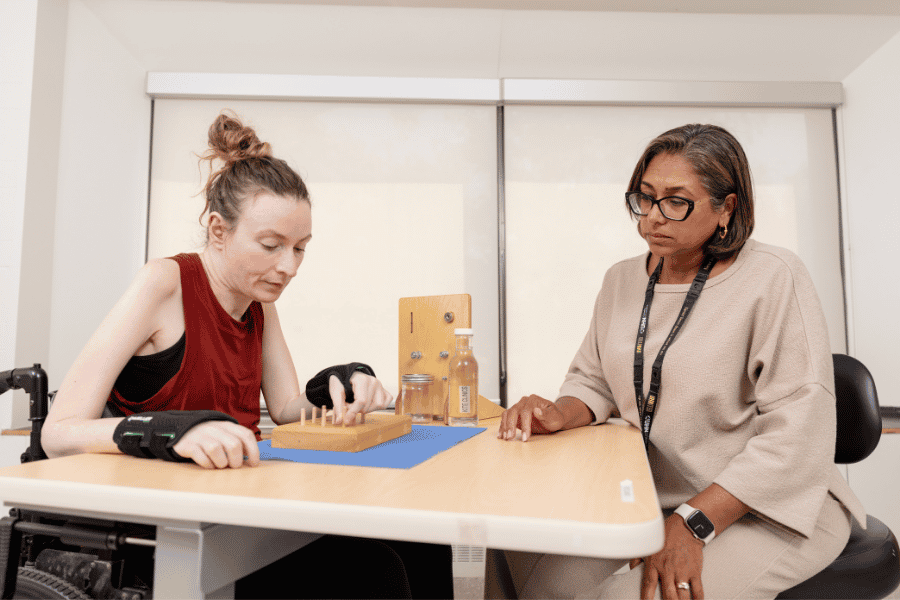
Melissa Charpentier, left, completes a task as part of a clinical tool developed at UHN by Dr. Sukhvinder Kalsi-Ryan, right. (KITE Studio)
Dr. Sukhvinder Kalsi-Ryan, a clinician-scientist at UHN’s KITE Research Institute, created GRASSP with an international multidisciplinary team to help solve a critical problem in spinal cord injury research.
A clinical assessment tool developed at UHN helped motivate Melissa Charpentier through a “very long and slow” recovery.
Melissa lives with spinal cord injury and partial paralysis, sustained in a 2013 car accident. Early in her recovery, typical tasks — from eating and personal care to independently repositioning her body — were a challenge.
Graded Redefined Assessment of Strength, Sensibility and Prehension (GRASSP) is a tool that measures hand and arm function in people living with tetraplegia, a form of paralysis that affects all four limbs and the torso following damage to the cervical (neck) spinal cord.
Using real-life tasks, such as inserting a key into a lock, GRASSP helps measure incremental strength, sensation and grasping abilities in patients, like Melissa, who are recovering from spinal cord injuries.
For Melissa, who took part in a research study involving the tool at UHN’s Toronto Rehab Lyndhurst Centre, GRASSP was a positive experience compared to existing tests.
“It's a little more encouraging because, even if you're not completing the task, it gives you a breakdown of the task elements that you are able to accomplish, providing a more positive outlook," she said.
Dr. Sukhvinder Kalsi-Ryan, a clinician-scientist at UHN’s KITE Research Institute, working with an international multidisciplinary team, launched the tool in 2009.
“After creating something meaningful, we did not want it to sit on a shelf as a manuscript,” says Dr. Kalsi-Ryan.
“If you don’t actually get a tool into people’s hands in a scalable way, it’s not helping patients. That was always our guiding principle.”